Part 2: What Clarity Actually Looks Like When You Strip Away the Buzzwords
Blog post description.Clarity doesn’t usually arrive in a lightning-bolt moment. It shows up in honest conversations, uncomfortable trade-offs, and quieter decisions. In this post, Karas unpacks what clarity actually looks like beyond the buzzwords, and why revisiting it is essential for sustainable leadership and business growth.
SYSTEMS THINKINGCLARITYBUSINESSGROWTH
Karas Wright
2/2/20264 min read
Clarity has become one of those words that sounds good but means very little once it’s overused.
It’s often packaged as confidence, inspiration, or a polished vision statement that fits neatly into a slide deck. The kind of clarity that sounds impressive when spoken out loud, but doesn’t necessarily change how decisions are made on a Tuesday afternoon when things feel messy.
That version of clarity is clean and aspirational. Real clarity is rarely either.
Clarity Is Orientation, Not Certainty
Clarity does not mean knowing exactly how everything will unfold. It doesn’t remove doubt, risk, or complexity. What it does provide is orientation.
When clarity is present, you know what you are solving for. You know what matters most right now, even when there are many good options pulling at your attention. You know which trade-offs you are willing to accept and which ones you are not.
Clarity often sounds quieter than people expect. It shows up in sentences like:
This is the problem we are committed to addressing at this stage.
This matters more than the other opportunities available to us.
This is where we are willing to say no, even if it costs us in the short term.
It is not the absence of doubt. It is the presence of direction in spite of it.
What Clarity Looks Like in Practice
When clarity is real, it becomes visible in the way a business or leader operates.
You can explain who the work is truly for, without trying to make it fit everyone. You can articulate what success looks like now, not just in some future, fully-realized version of the business. You can name what you are prioritizing this quarter, even if it feels incomplete or imperfect.
This is where clarity starts to feel uncomfortable.
Clarity creates boundaries, and boundaries force trade-offs. They remove the safety of keeping everything open “just in case.” Once clarity is named, avoidance becomes harder to justify.
This is often where people stall, not because they don’t know what they want, but because choosing means letting something else go.
The Myth of “Crystal Clear”
One of the most damaging ideas around clarity is the expectation that it should be absolute and permanent.
As though once you find it, it should lock into place and never need revisiting.
That isn’t realistic for humans, and it certainly isn’t realistic for businesses.
Clarity is contextual. It evolves as you gain experience, encounter constraints, and learn more about yourself and your work. What felt clear five years ago may feel limiting today. What once energized you may no longer fit who you are or how your life has changed.
This doesn’t mean the earlier clarity was wrong. It means it served its purpose at that time.
The problem isn’t changing clarity. The problem is continuing to operate from outdated clarity out of habit, loyalty, or fear.
When People Think They Have Clarity (But Don’t)
There are a few common substitutes for clarity that show up again and again.
Busyness often masquerades as progress. Long lists replace real priorities. Vision statements exist without any accompanying decision criteria. Language sounds confident, but actions remain misaligned. When everything feels important, clarity is missing. When decisions keep getting revisited, clarity hasn’t been anchored.
When strategy shifts primarily in response to urgency or external pressure, clarity is not leading the work.
Clarity Reduces Cognitive Load
One of the most overlooked benefits of clarity is how much mental and emotional energy it frees up.
When clarity is present, fewer decisions feel personal. You stop re-litigating choices you’ve already made. Your nervous system doesn’t need to stay in a constant state of alert, scanning for the “right” move.
This is why clarity is foundational to sustainability.
Without it, even highly capable leaders burn out. Not because they aren’t working hard enough, but because they are constantly negotiating internally — weighing options, revisiting decisions, and carrying unresolved tension.
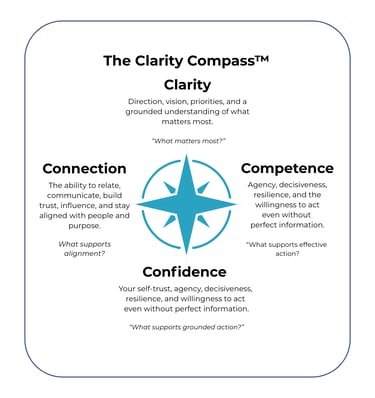
The Role of the Clarity Compass
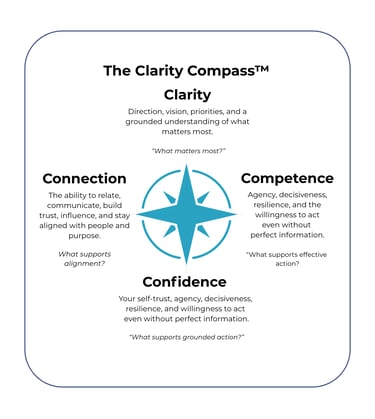
This is where the Clarity Compass moves from concept to practice.
Clarity within the Compass isn’t about having all the answers. It’s about orientation. It helps you name what has shifted, recognize when old definitions no longer fit, and pause long enough to recalibrate before trying to optimize or scale.
Clarity is not the finish line. It is the starting point that allows for you to become intentional again.
A Question Worth Sitting With
If someone asked you to explain, plainly and without aspirational language, what your leadership or business is in service of right now, could you?
Not what it might become one day.
Not what sounds good externally.
But what is actually guiding your decisions today.
If that question feels harder than expected, nothing is wrong. It simply means clarity is asking to be revisited.
What’s Coming Next
Part 3: Where Competency Belongs, and How to Stop Becoming the Bottleneck
Because once clarity is restored, the next question becomes unavoidable:
How do you need to operate differently to support it?
About the Author
Karas Wright is a business and leadership coach and the founder of Wright Step Coaching. With a background spanning corporate leadership, banking, and entrepreneurship, Karas works with leaders and business owners who are capable, driven, and tired of operating without clear direction. Her work is grounded in the Clarity Compass, a practical framework designed to help people lead and build businesses with intention, steadiness, and sustainability. Karas is also the host of The Karas Wright Show, where she explores unfiltered conversations about leadership, business, and the human side of growth.
coaching for lasting effectiveness and accountability
Contact Us
📧 hello@wrightstepcoaching.com
📞 403-861-9917
© 2025. All rights reserved.