
The Double-Edged Nature of Vulnerability in Business
This article explores the real dynamics of vulnerability in business. Drawing from a career in highly structured environments and a decade-long process of removing professional and personal masks, it examines both the benefits and the risks of openness. A candid reflection on why vulnerability builds trust in the right containers, why it can backfire in others, and how intentional adaptation, not radical transparency, creates sustainable leadership.
BUSINESSAWARENESSLEADERSHIP
Karas Wright
1/24/20264 min read

And why discernment, not disclosure, is the real leadership skill
For a long time, I believed professionalism meant control.
Not emotional regulation. That is different. I mean containment. Precision. Polish. The ability to show up composed, no matter what was happening beneath the surface.
That belief did not come out of nowhere. I grew up in structured environments and spent 25 years in banking, a system that rewards predictability and punishes uncertainty. In that world, credibility is built through consistency, not candor. You learn quickly which parts of yourself are acceptable and which should stay private.
So I adapted.
I became presentable. Reliable. Professional. The composite of leader, wife, and mother that the environment expected.
None of that was false. But it was not the whole truth either. It meant I did not share my thoughts openly, and I did as I was mandated to keep the peace, even when it was against my better judgment.
The masks start earlier than we think.
Looking back, what surprises me most is how early I understood this adaptation process.
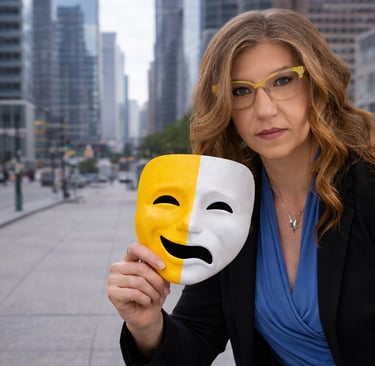
When I was 13, I started collecting masks from around the world. Literal ones. Different cultures, materials, expressions. At the time, I did not have the language for why they fascinated me. Now it is obvious.
They were a physical representation of the masks I was already learning to wear.
Each mask served a purpose. Each one helped me belong, succeed, or stay safe in a specific context. The issue was not that I wore them. The problem was that, over time, the mask became the default interface, and the person underneath grew harder to reach.
Removing the mask is not a moment. It is a decade-long process.
About ten years ago, I started dismantling those layers intentionally.
Not dramatically. Not all at once. But deliberately.
At one point, I began smashing some of those physical masks. It became symbolic. A way of acknowledging that I no longer wanted to lead solely through performance or protection.
At the same time, I started removing the theoretical masks too. The need to sound polished. The need to manage perception. The need to always have the answer before speaking.
The upside was immediate and tangible.
I experienced:
Deeper, more honest relationships
Decisions rooted in values instead of optics
A clearer direction on how I wanted to show up
A significant reduction in the cognitive load of leadership
A more genuine sense of self and where I belonged.
Vulnerability freed up energy. I spent less time managing impressions and more time actually leading. That benefit is rarely acknowledged. It matters.
The part we do not talk about enough: vulnerability has consequences
Here is the reality that often gets glossed over in business conversations about vulnerability. It is not universally welcomed.
Being open, honest, and transparent can deepen trust, but only in environments that are equipped to hold it. In others, it creates discomfort, misalignment, or unintended fallout.
I am candid. I speak directly. I often shoot from the hip. And sometimes, that does not land.
Not because it is careless or inappropriate, but because not every system values truth over harmony. Some organizations are optimized for risk avoidance. Some leaders equate composure with competence. Some people are constrained by duty, responsibility, or personal readiness in ways that make openness feel unsafe.
In those moments, vulnerability does not fail. Fit does, as does picking the right moment to have the conversation. Sometimes that means not at all.
What I am recognizing now: adaptation is not betrayal
This is the shift that feels most important to name. The best path forward is not radical transparency everywhere. It is an intentional adaptation depending on the environment.
And that adaptation is no longer unconscious.
When it is my container, my podcast, my programs, my community, I set the parameters. I am explicit about the tone, the level of candor, and the kind of conversation we are having. People opt in knowing what they are stepping into.
That is not control. It is ethical leadership. Clear containers make honesty possible.
When I am consulting inside someone else’s system, the responsibility changes. The work is no longer about self-expression. It is about service within a culture.
That means I take the time to understand:
The environment I am entering
The unspoken rules and power dynamics
What is rewarded, tolerated, or quietly discouraged
Where honesty will move the system forward, and where it will shut it down
This is not about shrinking or putting the mask back on. It is about being effective.
And just as importantly, I ensure alignment before engaging. The organization does not need to mirror me, but it does need to respect clarity, agency, and psychological safety. If those are not present, vulnerability becomes performative at best and damaging at worst.
Values still matter. Fit still matters.
The maturity phase of vulnerability
Earlier in my career, adaptation happened automatically. I shaped myself to survive. Later, vulnerability became a corrective. I removed the masks to reclaim truth.
Now, adaptation is conscious and values-based.
I know who I am.
I know what I stand for.
And I choose how I show up based on purpose, not fear.
That is the difference between:
Wearing a mask to belong
And adjusting your presence to lead
One is protective. The other is strategic.
A final reflection for leaders
The goal in business is not to be the same everywhere. The goal is to be internally consistent and externally intelligent.
When leaders confuse authenticity with uniformity, they burn out.
When they confuse professionalism with suppression, they disengage.
When they develop discernment, they become trusted, grounded, and effective across contexts.
That is the leadership I am committed to now. Not fewer masks. Better awareness. Clear containers. And values that do not shift just because the room does.
coaching for lasting effectiveness and accountability
Contact Us
📧 hello@wrightstepcoaching.com
📞 403-861-9917
© 2025. All rights reserved.